5 PG Movies from the ’80s That’ll Give You Nightmares

The ’80s were a different time. That’s all I have to say about that. Oh, except that I cheated with the title to make it snappier–some of these are rated G.

5. The Last Unicorn

A Rankin/Bass production, but not nearly so touchy-feely as their Rudolph the Red-Nosed Reindeer movie. A unicorn wonders why she hasn’t seen any of her pals lately, and it turns out that cruel King Haggard has a giant bull that chases them into the sea so he can watch them, because it’s the only thing that makes him happy. (Yes, this movie’s just as cheerful and life-affirming as it sounds.) In order to hide from the bull, her magician friend Schmendrick turns her human, but as she’s used to being immortal, her decaying corpse of a body freaks her out. Despite falling in love with Haggard’s son Lir, she’s no Disney princess. In fact she spends much of the movie being an arrogant twat. I still enjoy it as an adult, but I’m not sure what appealed to me about this movie as a child, unless it was the creepiness factor.

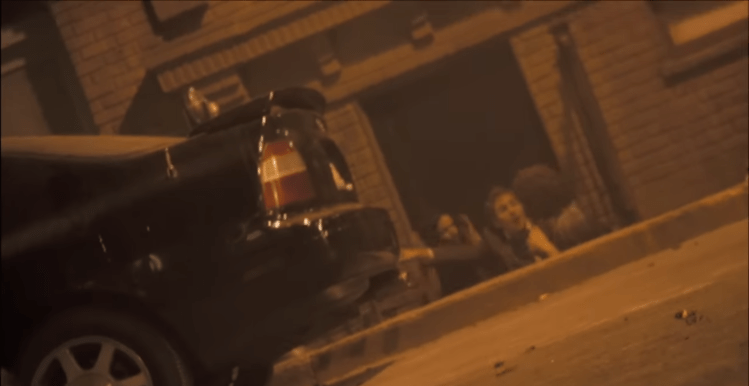
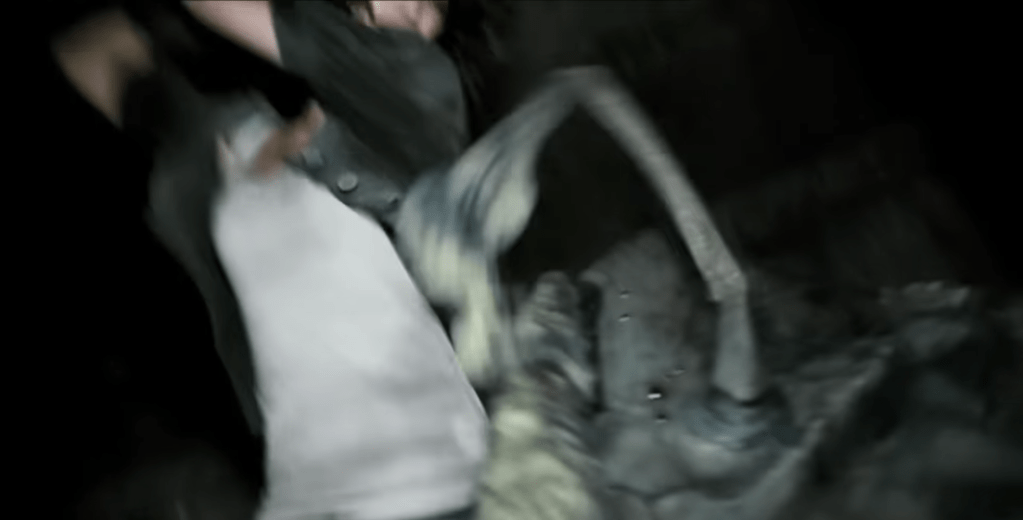
Consider the following sequence: the unicorn has been taken prisoner by carnival owner Mommy Fortuna. She’s also in possession of a harpy, which is REALLY pissed about being in a cage. Does Mommy Fortuna care? Nah. She’s like, “Welp, she’ll kill me one day. Whatevs. Yolo.” The unicorn frees the harpy, which by the way has three boobs just a-hangin out, nipples and all, and may I remind you this movie is rated G, and she indeed kills Mommy. You can see her corpse in the foreground as the harpy also goes to town on Mommy’s fuckwit assistant.

Also disconcerting is the scene when Schmendrick is tied to a tree that becomes sentient and acts distinctly sexually harass-y. She virtually smothers him with her big tree bosom.

Here’s the red bull chasing the unicorns into the sea. Wholesome family watching all around!

4. The Secret of NIMH

This is a movie by Don Bluth, the man who left Disney to make his very own child-traumatizing tearjerkers about dead parents. The very first line of the movie is “Jonathan Brisby was killed today while helping with the plan.” The plot centers around Jonathan’s widow Mrs. Brisby, a field mouse who has a deathly ill son and needs to move her house before the farmer who lives adjacent plows his land and crushes her family to death. As a mouse, she faces all number of dangers, including a plow, a malicious cat, a giant owl, and hostile rats. The rats are supersmart because they were experimented on in a lab. During a flashback we’re treated to images of hyperventilating bunnies, a fearful mother monkey and her babies, whining puppies, and rats getting shots in the gut with bigass needles. The only comic relief in the movie is Jeremy the crow. And occasionally the children. Except at the end of the movie, when they’re drowning in mud. We’re talking about a character getting crushed by a cinder block, leaving some of his limbs sticking out.

Lookie here: Mrs. Brisby ventures off to see the Great Owl, not generally a friend of rodents. She is followed by a gigantic, terrifying spider, drooling with the anticipation of eating her. The Great Owl crushes it to goo, shocking Mrs. Brisby. We then see that his head is upside down, and he flips it around. For good measure, his eyes are glowing and he’s completely covered in spiderwebs.

3. Who Framed Roger Rabbit

Hollywood, 1947. Eddie is a tough gumshoe who’s mixed up in a murder case involving live folks and animated characters, who exist in the world of humans but live in segregation from them. The special effects are amazing, especially for the era.

Eddie’s nemesis is the evil Judge Doom, who really hates the cartoons. Here we have a scene when a childlike shoe nuzzles his leg. Doom, illustrating that he has a new way to kill toons, picks up the shoe and melts him alive while the little feller gazes at him beseechingly. Doom emotionlessly displays his dripping red glove.

Or (*38-year-old spoiler) the scene when Doom is revealed to himself be a cartoon. He’s flattened with a steamroller, while, as the closed captioning states, “screaming” and “gibbering.” His fake eyes fall out to reveal crazed animated orbs, and he wastes no time attempting to kill everyone around him with his toon superpowers.

2. All Dogs Go to Heaven

“You can never come back…’

Another Don Bluth classic. New Orleans, 1939. Charlie is a seedy German shepherd out to gamble and have a good time at others’ expense. When his business partner murders him so he can have all the profits for himself, he gets Charlie drunk and runs him over with a car. Charlie is able to trick his way back to earth, heedless of the warning that he can never come back, and continues business as usual, this time with virtuous orphan Anne-Marie, who can talk to animals. Since it is (ostensibly) a childrens’ movie, he learns a lesson about not being a cunt and is able to return to heaven at the end.

The following sequence is a dream Charlie has about being condemned to hell, complete with lava lakes, skeletal pterodactyls, and mini-demons who bite him mercilessly.

However, the far more disturbing scene is when Charlie and Anne-Marie are held hostage by a gang of rats that appear to be what white people think African people look like. Anne-Marie is unable to communicate with them because “They talk funny.” Then their boss shows up, an alligator with a bone through his nose and decidedly more generous lips than a cartoon alligator would typically have. And yes, it is a Black gentleman who voices him. Not only is it blatantly offensive, it has such little bearing on the plot that it would go on to spur its own movie trope, known as the big-lipped alligator moment. To add insult to injury, the gator goes from menacing to a fawning gay stereotype after his attempt to eat Charlie results in a howl that impresses him with its musicality. (Which is ironic because voice actor Burt Reynolds garnered a lot of complaints about Charlie’s singing.) The reptile dons a flowered headpiece and grows eyelashes and makeup out of nowhere and sings a love song to Charlie about making music together.

Is this better or worse than my number one pick? Well, at least this movie has Melba Moore:

1. The Elmchanted Forest

This is a Croatian/American effort, the internets tell me. I watched this many, many times as a young child, and for the life of me I don’t know why I liked it so much. The animation is just ugly.

Yeah they don’t get it, either

The writers’ idea of humor is endless lazy puns and ethnic stereotypes such as a lizard who sounds like Super Mario and a French fox (also the only female character who has any significant dialogue) who spends her screentime being vain and coy. So to sum up the plot, Peter is a painter who is magic-ed by a tree to make him understand the forest animals. They’re being menaced by the bitter Emperor Spine, who’s set on decimating the woodlands. The animals are obnoxious, from cutesy hedgehogs who say things like “Yummy tummy!” to a sports-obsessed bear and a beaver who makes horrible clicking noises. There are multiple scenes that dissolve into blood-curdling psychadelic sequences for no particular reason:

When I was a kid, the only thing I found off-putting was a scene when the Cactus King’s servant is imprisoned in a tower to await execution by shredding machine. There’s an ominous mega-’80s song with tubular bells and a drum machine playing in the background. Don’t ask me why a giant robotic guillotine needs a shredding machine.

As an adult, the entire film is off-putting, but the worst offender is the sequence when Peter is trapped in a cave underground with mushroom creatures who want to turn him into one of them. When he refuses, they sing a creepy song and grow fangs. If you’ve never heard of this movie it’s probably because it hasn’t been released on DVD in the US in 25 years because the head of security and his three backup singers look just like historic racist caricatures of Black people:

I can’t make light of something so disgusting, especially because my white privilege allowed me to completely forget this scene existed–not that I would have recognized blackface imagery as an elementary schooler anyway. But I can’t leave you without a palate cleanser, so here’s Janelle Monáe:

And because I can, here’s a vintage clip of national treasure Maru, the delightfully chonky Scottish fold from Japan:

Sweet dreams!

“Hold Your Breath” in About 30 Seconds

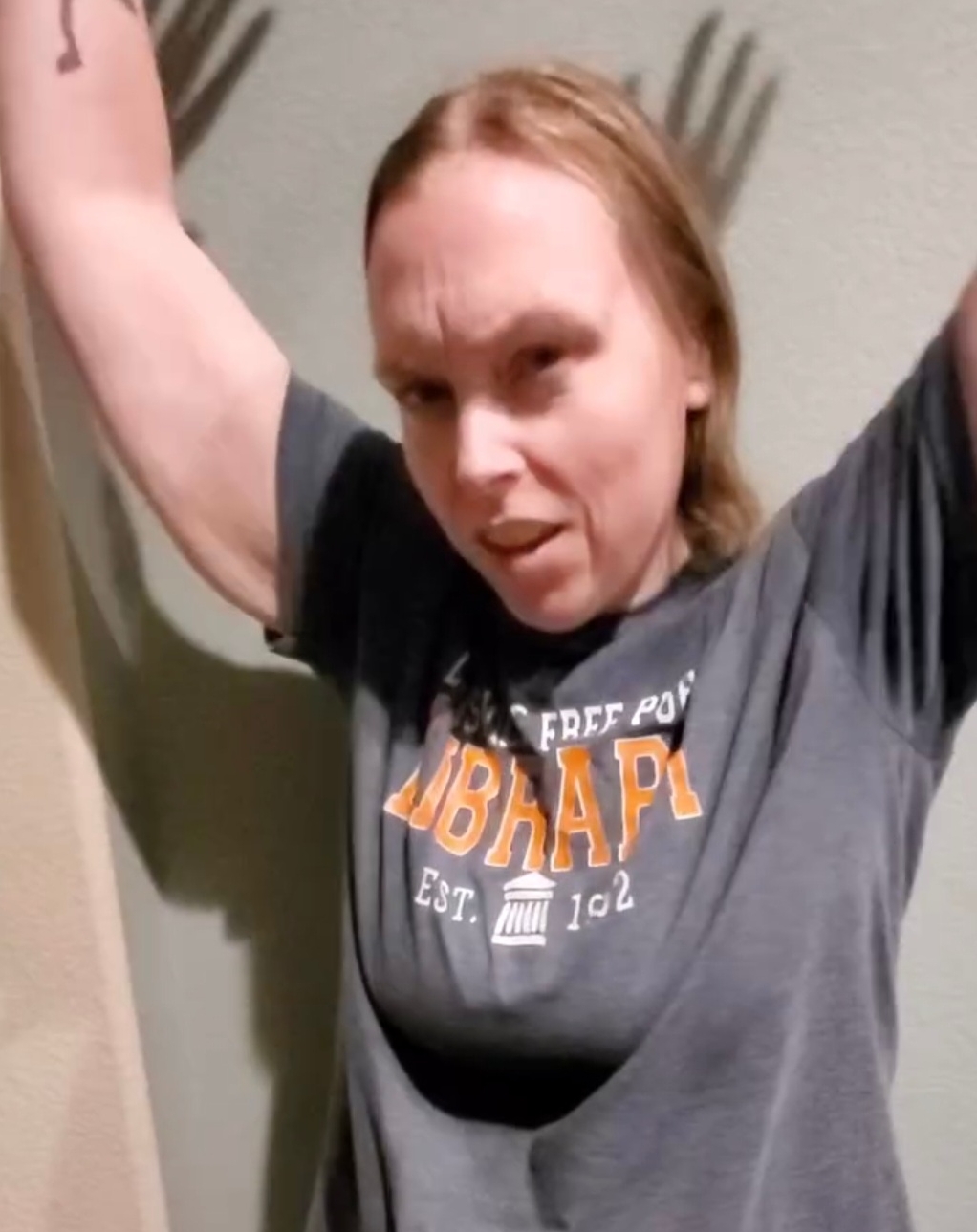
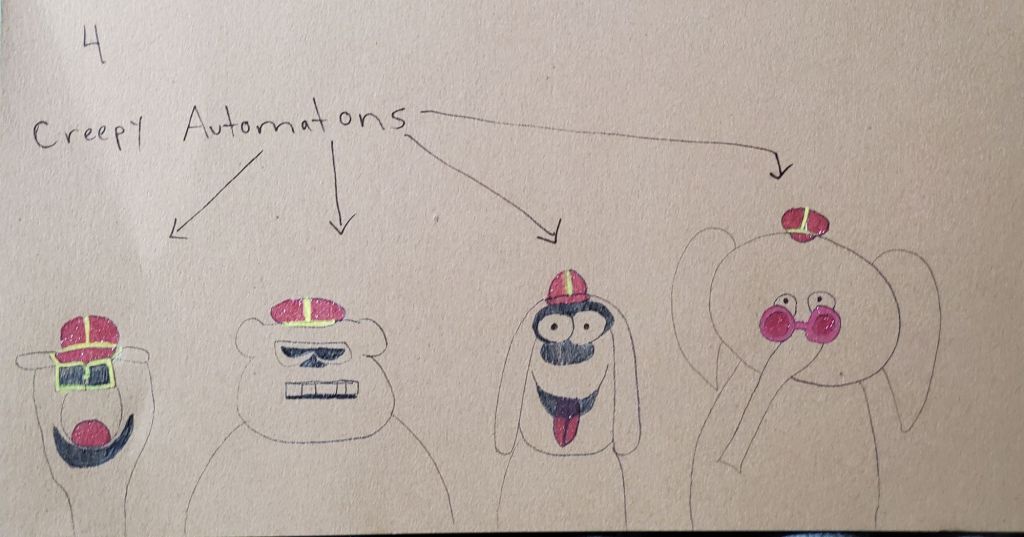
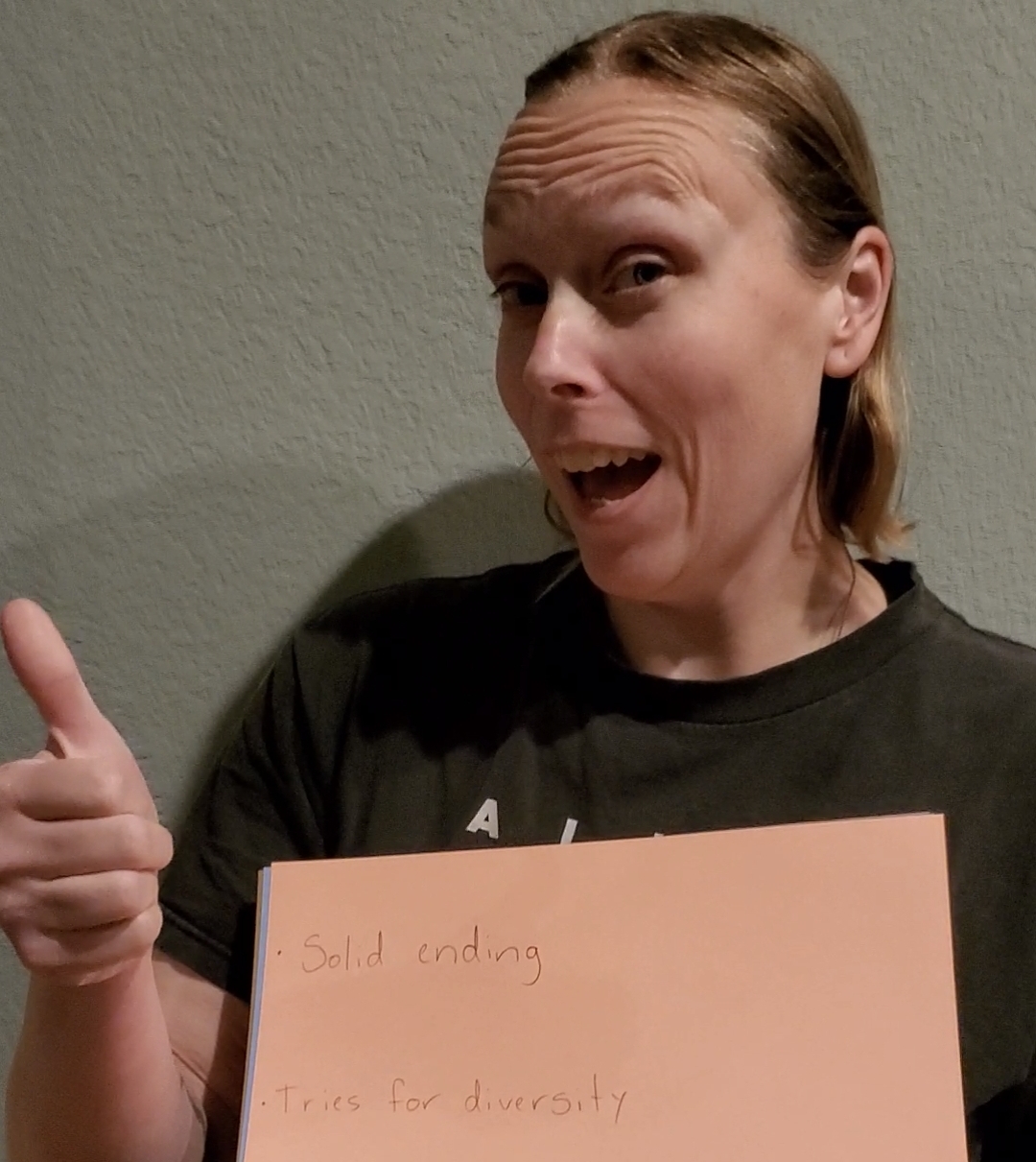
I made another Instagram reel, based on my earlier post about this movie. My oldest kid filmed it. Images of my sparkly, sparkly cue cards are below.

(Though technically the Dorothea Lange photo above was taken in California, not Oklahoma. Right time period, wrong state. Courtesy of https://www.pbs.org/wnet/americanmasters/dorothea-lange-biography-with-photo-gallery/3097/)

The Horrors of Adulting: Cheap Murder House

I made this with a real estate flyer template–the info above is straight from the house tour scene in The Amityville Horror

Ah, the cheap murder house, a staple of horror movies. Someone, usually a couple of someones, buys a suspiciously affordable living space only to find that it’s priced that way for a good reason. Most often it’s haunted by the ghosts of people who murdered and/or were murdered there. (Though sometimes the problem is a more whimsical issue like a portal to hell.) Inevitably, the new owners will have a conversation that goes something like: “We have to get out of this house! Do you know what a difficult time I’ve been having getting these spectral bloodstains out of the floors?” “But we’ve sunk everything we have into this! Let’s just get a priest and an industrial carpet shampooer. The kids will quit peeing themselves and come out of the TV once they adjust to the new neighborhood.”

And the money issue is nothing to sneeze at. The choice to stay, not only so the movie can happen, is regularly based on the economic difficulty that would occur from backing out of buying a house and having to get a non-haunted one. Often there is a sense of tension built from mounting bills. So the real horror is being broke. (An exception being Insidious, in which case the family goes to a new palatial dwelling with no financial inconvenience despite the fact that the wife is an unemployed musician and the husband is a school teacher.)

But, despite financial hardship, eventually the time comes to learn the timeless lesson (©GhoulieJoe) that you can’t live in a cheap murder house if you’re dead.

What was the point of this post, you ask? I put a lot of work into that meme, dammit!

Horror Cinematherapy: The Power of Belief

Belief. It’s a major player in the world of horror movies. Often the characters who don’t believe in the monster are the first to go. Frequently the antagonist thrives on the fear that comes along with belief, like Pennywise in It. In psychology, belief is tantamount to mental health. A common tactic for improving self-esteem and coping with depression and anxiety is Cognitive Behavioral Therapy, the cornerstone of which is confronting and changing destructive thought patterns. The following ten movies illustrate, in the words of Marie Forleo in her book Everything is Figureoutable, “It doesn’t matter what’s true, it matters what you believe.” (PS: I have an associates degree in Social Science, which means I am qualified to…write listicles about certain aspects of psychology as they relate to horror movies. That’s it.)

The Skeleton Key

Caroline is an in-home caretaker who has just taken a job for an older couple. The husband, Ben, had a stroke and is almost completely paralyzed. Unfortunately for her, Caroline is now in the midst of hoodoo country, and soon she discovers that something sinister is behind Ben’s condition. As one does, she begins spending her time snooping rather than doing her job, and finds a shocking truth that upends her sense of reality.

The philosophy regarding magic in the film is “It can’t hurt you if you don’t believe.” Naturally Caroline starts off as a stodgy skeptic, illustrated rather cringily as a learned white lady going among superstitious weirdos of color in the bayou. There’s a consistent image system of locks and chains, with magic being the key to the locks; therefore, by association, lack of belief can hold a person captive. It’s her self-assured attitude that gets her in trouble; she’s warned repeatedly that she’s in danger if she stays, but her refusal to listen paired with a trauma-driven urge to stay with Ben no matter what keeps her in harm’s way.

A Cure for Wellness

Lockhart is a high-powered businessman sent by his firm to a Swedish health spa to fetch Pembroke, who went there for a two-week treatment and suspiciously refuses to return. On his way out, Lockhart is in a car wreck and wakes up in the spa with his leg in a cast. He finds himself under the staff’s care whether he likes it or not. And, given their horrifying methods of “treatment” (for example eels going into orifices they one hundred percent do not belong in), he really doesn’t like it.

Lockhart discovers that no one is actually getting cured, and the place is in fact feeding off of its clients. But the wily director Dr. Volmer has a way of convincing people they’re ill, from the patients to his ward Hannah, a sickly childlike waif. Volmer’s patients feel better because they’re told they feel better, even as they’re dehydrating and losing their teeth. You can read the film as a diatribe against the emptiness of modern life. Lockhart is endlessly chasing prestige and a corner office, because in our culture we’re told that is the thing to want, despite a flashback showing his father jumping off a bridge, briefcase in hand, after a stock market downturn. Lockhart’s superiors are ruthless and cruel, as is the world of business: the film opens with a prominently featured salesman of the year having a heart attack at the office and dying alone. Success is an illusion.


Bug

Agnes is a lonely waitress living in a dank motel room when she meets Peter, a veteran who’s convinced he’s being followed by the Army in order to experiment on him. We later find out he’s schizophrenic, but Agnes is vigorously in denial that anything’s amiss, even when Peter sees bugs everywhere, including in his blood under a microscope, and he drags her into his delusions.

Agnes is easy to convince. Part of it is her crushing isolation, exacerbated by the disappearance of her young son and her good-for-nothing ex Jerry. She’s willing to believe anything so she won’t have to be alone, even if that belief is “You’re never really safe.” When Peter tells her that smoke alarms are radioactive, she believes him immediately, concluding that that’s why she feels so lousy all the time. Peter is self-destructive and paranoid, and they feed off of each other. As time goes by, Peter is yanking out his own teeth and Agnes is digging so fiercely at her skin that she’s getting rashes and gouges. The two are twitchy and swatting at invisible insects. They’re not in danger, they’re a danger to be around.

Oculus

Kaylie and her brother Tim are dealing with the trauma of their father torturing and killing their mother while under the influence of an evil mirror. The ghosts that inhabit it are highly influential, capable of inducing realistic hallucinations. As adults, Kaylie snatches Tim fresh out of a mental facility and plans to capture video evidence of the glass’s shenanigans. She takes super precautions like having her fiancé call on the hour, setting alarms to eat and drink, and rigging an anchor to smash the mirror. Meanwhile, Tim, attempting to hold on to his hard-won sanity, tries to talk her out of it.

The Lasser Glass is able to completely unmoor people from reality. They believe that things that are harmful don’t hurt. They are confused about what is real, for example a scene when Kaylie is eating an apple, which changes into a lightbulb. She sees the bits of bulb and fishes a shard out of her bloody mouth, but then it’s revealed she was actually only eating the apple after all. Characters doubt their memories and rationality. Tim tells Kaylie, “You’re remembering it wrong.” “I’m not crazy!” their mother Marie shrieks. It’s all too easy to fall under the mirror’s spell; unfortunately, there’s not a cut-and-dried solution. In the end, as the movie trailer puts it, “What is past What is present What is real What is deception You see what it wants you to see.”

God Told Me To

Peter is a detective witnessing an alarming uptick in senseless murders committed by people claiming “God told me to.” A deeply religious man, Peter is unshaken in his faith and sets out to solve the case. He discovers a devastating truth about himself instead.

The murderers, if they live (some kill themselves after), are oddly jovial. One man, after shooting his wife and two children, discusses how good it felt to make a sacrifice for one who gives so much and asks so little, telling Peter, “You don’t love God the way I do.” The film is a study of a man who actually does love God very much but is forced to choose more than once between his feelings and the rules set forth by God–he cheats on his estranged wife and lives with his new lover. Both women are surprisingly chill about it (oh the ’70s!), but the Bible clearly states that’s a no-no. He’s baffled by the series of unexplainable events happening around him, but it’s pointed out in the film that God is wont to use fear to motivate people rather than miracles. Is God demanding a sacrifice? Are the victims destined to die? How do you decide what is right when you’re chosen to do something unspeakably awful?

The Deliverance

Ebony is a single mother of three who along with her mother has just moved into a cheap murder house inhabited by a demon. They’re a deeply troubled bunch, and the entity preys on the family tension.

As the title cards in the opening state, “I need forgiveness for what I have done, but I also need deliverance from what I am.” Ebony is a hot mess. She’s an alcoholic and battling major childhood trauma of multiple kinds. She feels guilty afterwards, but she’s abusive to her loved ones as a result. Even if you’re not a Christian, you must concede that Ebony needs Jesus. The literal demon symbolizes personal demons and the power of self-destructiveness. Ebony can’t fight back until, as Apostle Bernice says, “You gotta know that you’re loved.” In order to get rid of the demon, she has to conquer doubt and fear and the notion that “Nobody loves you.”


She Dies Tomorrow

Amy has just bought a house, one of the basic tenets and lengthy commitments of adulthood. Buuuut sadly she’s dating a feller named Craig who suddenly has a premonition that he will die the next day. Amy is taken in by the notion and becomes convinced that she too is going to die. Her friend Jane becomes invested as well, and soon everyone Jane speaks to shares the conviction that tomorrow is their last day on earth.

The film explores the state of denial that most of us tend to live in about how much time we do or don’t have. We know for a certainty that we’re going to die, but a lot of times we don’t act like it. The characters in the film, while devastated, begin to try to make the most of their situation. Jane’s brother Jason’s friends Brian and Tilly are motivated to painful but necessary acts, Brian by taking his father off of life support and Tilly by breaking up with Brian. Jane’s sister-in-law Susan muses about the stupid stuff people care about (in an earlier scene she has a monologue about dolphin mating habits). Amy and Craig discuss their regrets. Jason admires the sunrise. Jane seeks out the company of strangers, who are already also possessed of the idea that they’re going to perish the next day. None of them have concrete evidence that they’ll actually die so soon, but they have a compelling certainty, and it’s enough. As Brian says: “We all have to die at some point. Why not tomorrow?”

We Go On

Miles is a man ruled by multiple phobias. His fear of dying leads him to place an ad stating that he will pay $30,000 for proof of life after death. After a disappointing series of fakes, he hits the jackpot and unwittingly opens the door to the afterlife–and a malicious ghost that wants to take him for a ride.

The film is about living with fear and uncertainty and learning to cope with adversity. According to one of Miles’s new acquaintances, the ability to see ghosts is ignited by fear and powerlessness, the kind experienced by children, and blocked by skepticism. Miles wants to believe, while his mother Charlotte is cynical and would rather there be nothing after death, because that means no judgment and no earthly tasks left incomplete. As she says, “We go out like lights. What else would we do?” Miles, always seeking safety, refuses to drive because of the potential for accidents and has the most boring job in the world: editing informercials. Because he spends so much time focused on both his traumatic past and his wariness of the afterlife, Miles takes his life for granted. It’s his encounter with the undead that gives him the motivation to do things that make him happy or that scare him.

The Empty Man

James is a former cop who now owns a security company. His neighbor Nora comes to him for help when her teenage daughter Amanda goes missing shortly after summoning the Empty Man, a creepy urban legend. James follows the clues to the Pontifex Institute, home to a cult also dedicated to communicating with the Empty Man.

The Pontifex Institute’s ideology is a more sinister version of that book The Secret: manifest your desires, and what you think about will be attracted to you. They live to “unleash the power of your mind.” Unfortunately, what their minds are unleashed to do is create a tulpa, a thought-person made real. They tend to the philosophy, as expounded by Amanda, that “Nothing can hurt you because nothing is real […] What’s real starts here [indicates her head] and ends up out here. I mean, what we think about with focus, and intention, and repetition, we manifest.” However, the Empty Man is able to influence people to do things they otherwise might not, such as stab themselves in the face with scissors or kill their beloved pet. The Pontifex people come across as desperate to believe in something, anything, even if it’s incredibly harmful.

I Saw the TV Glow

1996. Owen is an anxious 7th grader who’s smothered by his overbearing father and terminally ill mother. He befriends Maddy, an intense 9th grader who’s obsessed with the TV show The Pink Opaque, about two teenage girls named Tara and Isabel who have a psychic link and fight monsters (think the cheesy acting and special effects of The Mighty Morphin Power Rangers meets the badass female protagonists of Buffy the Vampire Slayer and the vintage creepiness of Are You Afraid of the Dark?). Maddy is being abused by her stepfather and takes a massive amount of comfort in her show, idolizing butch and powerful Tara. She disappears one day, and everyone assumes she’s dead. She returns eight years later, convinced that she left her boring life to enter The Pink Opaque. She tells Owen that she is really Tara and he is really Isabel, and that like on the show, they have been poisoned, buried alive, and brainwashed by the evil Mr. Melancholy to believe that they’re someone else. The only way to get back to their real selves is to recreate the burial. Owen has a difficult choice to make about whether to believe her, seeing as he’ll die a horrible death if she’s delusional.

It’s left unclear whether Maddy was right, but there are clues that she may be. As Owen muses, “Some nights, when I was working late at the movie theater, I found myself wondering, what if she was right? What if she had been telling the truth? What if I really was someone else? Someone beautiful and powerful. Someone buried alive and suffocating to death.” His real-world existence reflects that statement, as his asthma has him literally suffocating. His life choices are also suffocating: he grows up to become the restocker of the ball pit at the Fun Center, where despite his claim that he is now a man, he’s in a perpetual childlike state, surrounded by kids’ birthday parties all day. He regrets his choice not to do the seemingly crazy thing and join Maddy, but he’s still paralyzed by doubt. Owen and Maddy seem to have the tools in front of them to make transformation possible, but it requires sacrifice and unwavering belief.

The Horrors of Adulting: Labyrinth of Peopling

I’m late, y’all. Late to the autism party. But I’m finally here.

I’m an older millennial, and I was introduced to the concept of neurodivergence sometime in the twenty-tens, probably. When I could spare a thought its way, I derided how doctors were over-diagnosing and throwing pills at kids. Something something Big Pharma? Case closed. What I was basing that on, I can’t say.

Flash forward to my late thirties, when I had my son Jack. He was a handful from the start. Every night, from around 6 to 11 pm, he’d scream inconsolably. Walking and rocking and carrying and feeding did not help. We called it “colic o’clock” and got used to it.

Jack was suspected of having learning disabilities at around 18 months, when he was not hitting the general milestones for kids his age. For example, he did not want to walk. He had the muscle strength, he had the know-how, he just didn’t wanna. Enter his physical therapist, the marvelous Colleen, who had him up and about in what seemed like two minutes. She just held up a toy he wanted, and he stood up and walked to it.

Jack is also nonverbal, a trait that remains to this day, when he is four. My mother told me I was a late talker, too: “You just didn’t have anything to say,” she reported. I grew up sensitive, given to difficulty speaking to people. I have a memory of Mom trying to introduce me to someone while I hid behind her. My friend Paula, after listening to me gripe extensively about my OCD and how customer service jobs zap my strength, suggested that, like her, I may have late-diagnosed autism. She described the relief she felt when she realized “I’m a zebra, not a weird horse.”

In the interest of transparency, I haven’t been formally diagnosed, but I took an online test. And before you scoff, it was created by two doctors with autism, and it’s similar to a screener a professional would give–autism is not something you can determine with a blood sample. We’re not playing a guessing game of allergies/cold/flu/COVID–the symptoms aren’t vague and difficult to determine for sure without a nasal swab. Whilst writing this piece, I came across the lovely book The Autistic’s Guide to Self-Discovery: Flourishing as a Neurodivergent Adult by Sol Smith, and he explains concepts so beautifully that I have to steal some of his ideas. To quote him regarding the struggle to come out to others as autistic and being disbelieved:

“I don’t know anyone who has self-diagnosed because they knew someone who was autistic and thought that person was so cool. […] They never saw that they had anything in common with other autistic people, and when they heard the word or its description, they didn’t see themselves there. But when they heard about the struggles of being an outsider, wrestling with dysregulation over sensory issues, being repeatedly misunderstood, and feeling like their every effort makes their lives harder, it was then that they started their journey of self-discovery.”

The neurotypical party, which I go to every time I leave the house, feels like the ballroom scene in the movie Labyrinth (if you’re unfamiliar with this mid-’80s gem, please review the clip below), and I’m Sarah. Except I’m the one wearing a mask. (Though actually, if I’m any character in that movie, it’s Ludo, quietly helpful and eternally grateful someone wants to be my friend.) Any outgoing-ness on my part is faked unless I’m with people I trust. I was once told by a college instructor that I have a “flat affect”–meaning that I have a blank expression. Emoting with my face and voice does not come naturally. Inside, I may be ecstatic about a Christmas present, but you wouldn’t know it by looking at me unless I whip out my acting skills. I have big-time resting bitch face; repeatedly throughout the day I have to manually unscrunch my forehead with my fingers, because I frown unconsciously when I’m concentrating.

I’ve been working with the public since I was seventeen, when I was a shelver at the library. My coworkers taught me the basic niceties of exchanging pleasantries, and I moved from fielding questions from patrons by mumbling “You can ask at the information desk” to covering the storage desk, although I did cry one time when a particularly cranky patron did not get the issue of TV Guide that she wanted fast enough. I like the people-pleasing aspect of customer service, believing whole-heartedly in “wow moments” and other such smarmy slogans meant to encourage bending over backwards to make customers happy. In fact, I am obsequious to a fault. This is not uncommon for autistic people, as Smith explains:

“A lot of high-masking autistics are chronic people pleasers […] The issue is that once your identity and self-worth merge with making others happy, you can drift further from knowing yourself. When you learn how to mask, you learn how to people-please. […] People-pleasing is the highest form of masking because you learn not only to fit in but also to reflect back the person others want you to be.” Indeed, it’s disorienting to realize just how much I cast off my authentic self while growing up. I’m quiet, and that weirds neurotypical people the fuck out; they have responded to me with anything from gentle mockery to screaming, “Are you shy? I hate shy people!”

Being around others, even my loved ones, can wear me out. I have a tendency to obsess over every conversation I have with people, replaying them, scanning them for rudeness on my part or things that I may have done wrong, trying to decide if I was likable. When I have to talk with someone on the other side of a customer service setting, such as when I had to renew my California car registration after three years of living in Kentucky, I made sure to drag my husband along. He speaks the language of the normies. I plan and rehearse and sometimes write a physical script of what I need to say and accomplish, in fear that I won’t be understood or that I’ll forget something important.

Yes, they are staring. Unkindly.

Smith describes this social rumination very eloquently:

“One familiar autistic experience is rehearsing anticipated interactions. You aren’t ever sure what scenarios are going to come up the next school day, but many of us would lie in bed going through the motions in our minds. We would try to guess what the day would look like, whom we’d talk to, and what would be expected of us. Of course, this was only after we had finished unpacking the day we just finished–reviewing what worked, what didn’t, and what caught us off guard. While many kids do this, autistics do it to a pathological extent. We review our actions and words obsessively throughout our lives, always second-guessing whether we are coming across as ‘normal enough.’ […] The impression of ‘otherness’ becomes deeply embedded at an early age and never leaves.”

When I interact with people, I expect to be disliked, yelled at, and rejected. There are unwritten rules to social interaction that neurotypical people all seem to know (like sidewalk politics–it’s so awkward to be walking and someone comes from the opposite direction–eye contact, no eye contact? How do I give them enough space to pass me without seeming like I’m shrinking away from them in disgust, everyone knows this stuff but me, and no matter what I do I am doing it WRONG, and yes this is my brain all of the time), and I am not privy to them. Little did I know that this fear of rejection has a name; as Smith states:

“Rejection sensitivity doesn’t just mean that you dislike being rejected; it means you are so sensitive to it that you arrange your life to avoid the feeling at all costs. Worst of all, some people can experience rejection sensitivity dysphoria (RSD), a condition in which you see rejection in places where it hasn’t even taken place […] Going through life not looking for rejection but expecting it everywhere, we find it in unlikely places. We often figure that if we are one of seven people invited to dinner, our invitation came out of pity or because the host knew we’d find out about it and was just trying to avoid a problem […] Spending a life pretending to be someone you’re not has led you to conclude that who you are is not good enough for anyone.”

I can have difficulty with verbal commands, instructions, and directions. Often things fall out of my head the second I hear them. And I don’t always realize it. I’ll be nodding enthusiastically and then realize I absorbed nothing of what was said to me, and I’ll have to ask the other person to backtrack. Answering questions is fraught with anxiety, because I need extra time to absorb the question and then think out my response, while I feel pressured to answer not only instantly but articulately. Let me tell you, allistics (that’s the nice, non-othering, way to say neurotypical), if you make a statement or ask a question and you get back a blank, confused, or startled stare, repeating what you just said louder, faster, and angrier is not the way to go. And footie how, don’t get me started on my inability to remember a person’s name AND face; I’m lucky to retain one of them.

It’s common for autistics to have issues with employment. For social reasons, for sensory reasons (fluorescent lights are often majorly disruptive to the neuro-atypical), because job interviews are fucking hard if you’re not hemorrhaging charm and confidence. My biggest hurdle is meltdowns; as long as I can remember, I have had bouts of uncontrollable crying. With the right job, I can keep my shit together at work, but lately I’ve had a pattern of jumping from one low-hanging fruit to the next in a mad dash to find a job that’s not a soul-crushingly bad fit. I need a certain level of stability and familiarity to thrive. The job I left most recently was a retail job that felt unreasonably demanding, both physically and emotionally. I had a major crisis, feeling on the brink of hurting myself rather than continue going in. I haven’t cut myself in twenty years, but I could clearly picture the knife I would use, and I could see it going into my arm. Thankfully my husband’s sweet grandparents, who have taken us into their home with our three kids while we regroup from a cross-country move, held me up when I broke down. “Shouldn’t I just suck it up and go?” I wailed. “No,” they reassured me. They gave me the space and grace I needed to seek counseling and get a prescription for brain meds and find a better fit. I can’t count the number of times in the past I’ve berated myself for not being able to function like everyone else. It was a weight off my shoulders to discover that it’s not my fault.

Smith describes meltdowns thusly: “Adult autistic meltdowns happen when you lose agency over how emotions are processed in your body. Emotions happen in the more animal parts of your brain, and autistics (especially high-masking ones) have the habit of quickly bringing them into the neocortex. You think through your emotions by rationalizing what you are feeling, trying to talk through the logic and reasoning of your immediate disempowerment. When the emotions are too much, you feel like they take up physical space in the body and cannot be moved to the thinking part of the brain. Instead, they overflow, and your whole body fills with panic and chaos […] The overarching sense of powerlessness puts you in a feedback loop, spinning your thoughts and showing you cause/effect/cause/effect/cause/effect in quick succession. You feel isolated and alone, unable to help yourself, as if no one can help you. You might wave your limbs, hit your head, scream, be unable to talk, fall on the floor, or cry. For many people, this is an intensely physical reaction […] Something important about meltdowns: Once they are triggered, they cannot be stopped. You have to let them run their course until you are out of energy.”

Aaaaaand there’s the stimming. For the longest time, I mistook my boundless affinity for repetitive motions as anxiety-based, but now I know that I just really don’t like to be still. Pacing, rocking, calf raises, I like to move it move it. I don’t care what anyone thinks, I’m letting my fidget flag fly!

I have a tendency to conclude my pieces abruptly, and it’s tempting to do so here, because I am having difficulty wrapping this up without sounding too serious or preachy. To sum up, labels are useless, judging people is pointless, and I’m tired of trying to pretend to be someone I’m not. Oh yeah, I was talking about Labyrinth…um…look, it’s hot ’80s David Bowie!

Horror Cinematherapy: 10 Comedies to Ease Your Depression

I began my college career as a psychology major, and I have an AA in social science. Therefore, I am qualified to treat mental health issues…not at all. Whatsoever. Buuut I believe in the power of movies. It’s been proven that humor helps with anxiety and depression, so here are ten horror comedies that made me laugh.

Ghostbusters (2016)

Four lovable nerds (three scientists and a history/geography buff) battle ghosts. Their hopelessly incompetent but comely receptionist (Chris Hemsworth) helps, a little. I know a lot of people hated this one, but I find it gratifying that the ghostbusters are all ladies. It’s also terribly endearing how enthusiastic they are about their fancy ghost-fighting equipment. The performances are splendid; Melissa McCarthy and Kristen Wiig, whom I feel can go too far in comedic roles sometimes, are reined in here, while Leslie Jones and Kate McKinnon are delightful and quirky.

Hell Baby

Jack and Vanessa, an expecting couple, move into a cheap murder house, and Vanessa becomes possessed by a demon. The movie was meant to be goofy and pointless, and the genre trope parody is combined with unexpected silliness like the characters exclaiming in ecstasy over po-boy sandwiches. Leslie Bibb is inspired as Vanessa, who switches from sweet and unassuming to wicked in a flash, and Rob Corddry is great as Jack the frazzled everyman. The supporting cast, whom you may remember as most of Comedy Central’s lineup, shines as well.

Willy’s Wonderland

A nameless, mute gentleman, credited as The Janitor (Nicolas Cage), is roped into cleaning a defunct goodtimery establishment crawling with possessed animatronic mascots (think Five Nights at Freddy’s, or if you’re old like me, Chuck E. Cheese’s–you know those things are secretly evil) in order to earn money and get his car fixed. His utter nonchalance when the malevolent robots attack him is hilarious, as is his dogged determination to continue cleaning the restaurant even while dispatching its beloved characters. Who knew Nicolas Cage could be so funny yet so restrained?

Murder Party

It’s Halloween, and socially awkward Chris (Chris Sharp) finds an invitation to the titular murder party in the street and decides to go. The soirée is being thrown by a circle of experimental artists vying for grant money by turning a killing into performance art. They’re pretentious and greedy, but still somehow likable. But Chris! He’s so sweet and fragile. When he finds his pumpkin smashed, he makes pumpkin bread and brings it to the party. And his costume! It’s cobbled together from cardboard boxes and duct tape. The scene when Chris makes up his mind about attending the gathering, based on his cat refusing to get out of his chair, is comedy gold.

The Quiet Family

*Content warning: the plot involves an attempted rape. Also, a dog is kicked by a main character; it’s offscreen, but a yelp is audible, and it’s played for laughs.

Korean movie. A family with no business acumen attempts to run a mountain lodge but is short on customers. When they finally score one, he kills himself, and their luck only gets worse from there. From the opening, a jaunty pan through the house set to a rap song with mariachi trumpets, to the end credits with The Partridge Family’s “I Think I Love You,” music is used incongruously and surprisingly. The film is a meditation on the lengths people will go to in the interest of self-preservation, but the family’s progressively more ridiculous circumstances are presented in a skillfully comedic way.

Black Holler

It’s 1989, and LaQuita (Tamiko Robinson Steele) is embarking on a college class trip to a scary woods where various ancillary characters meet their doom. LaQuita is a badass final girl with martial arts training and a kind heart. It’s low-budget and cheesy, but purposefully so, and the humor is so random that I watched in a sense of bemused wonder. I was tickled by Brett, who swears he’ll never change but is played by a different actor in every scene he’s in. I didn’t find it consistently laugh-out-loud funny throughout, but it was fun and worth it for the jokes that land. Plus a little unpredictability is tough to come by.

Housebound

New Zealand movie. Kylie (Morgana O’Reilly) is making a long series of poor decisions when she’s caught trying to blow up an ATM. She’s sentenced to house arrest with her stepdad (Ross Harper) and her always-perky-and-well-meaning-but-occasionally-lapsing-into-racist-stereotypes (such as how Chinese people are “good wee little workers”) mother (Rima Te Wiata). Kylie is initially self-centered and angry about her circumstances, but soon she’s forced to grow up when it becomes apparent that her problems are worse than dial-up internet: the house is haunted. With the help of security officer/ghost hunter Amos (Glen-Paul Waru), she attempts to puzzle out what the apparition wants. Even at her most sullen, Kylie is still appealing, like in the scene when she’s so bored she gets out her old shoes and starts tap dancing.

The Lost Skeleton of Cadavra

Parody of ’50s sci-fi movies. Scientist Paul (Larry Blamire) and his wife Betty (Fay Masterson) head out to the woods to find a meteor and harvest its sweet sweet atmosphereum. Also hot on the trail of the space rock is evil scientist Roger (Brian Howe), his companion Animala (Jennifer Blaire), whom he assembled from mutated forest animals, and alien couple Kro-Bar (Andrew Parks) and Lattis (Susan McConnell). It’s filmed in “Skeletorama,” which I guess means black and white. It looks quite faithful to the decade, in both costumes and terrible special effects, and the actors nailed the stilted dialogue and mannerisms of bad movies from the era. Aside from mocking primitive mid-century mores, there are a wealth of amusing gags, like the dinner scene, below.

Haunted Mansion

An astrophysicist (LaKeith Stanfield) joins forces with a professor (Danny DeVito), a medium (Tiffany Haddish), and a priest (Owen Wilson) to help Gabbie (Rosario Dawson) and her son Travis (Chase Dillon) battle aggressive ghosts in their new mansion. Despite the un-Disneyish inclusion of alcoholism, dead spouses (dead parents, that’s a Disney movie!), suicide, and, saddest of all, product placement, it’s funnier than it sounds. In fact, the themes include the notion that grief can be a doorway to joy. The cast is awesome, and the characters are likable, particularly Gabbie and Travis, who have adjusted Poltergeist-style to their living quarters and its undead inhabitants. It’s a family movie, but it’s not cloying, and there are even some well-executed jump scares.

Extra Ordinary

Irish movie. Rose (Maeve Higgins) is a lonely driving instructor with secret ghost-whispering talents who meets a widower (Barry Ward) haunted by his cranky dead wife. Also in the mix is a once-popular singer (Will Forte) making a demonic sacrifice to start a comeback. The jokes are clever and cute, and the Irish way of speaking is just wonderful. Consider this voicemail left by Rose’s sister (Terri Chandler): “All right, Sis, it’s Sailor. C’mere. You better not be on that bloody bouncy ball, eatin yogurt and listening to ghost messages. Ah, c’mere, I’m not gonna call over at all tonight, ’cause I’m just so knackered, my feet are killing me. So, you can have dinner on your own. Lasagna for one, is it? All right, go on, I’ll talk to you later. Bye. I love you.”

Nostalgia Tiiiiiiime! Donnie Wahlberg and New Kids on the Block

During the misspent days of my young childhood in the ’90s, I was unhealthily obsessed with the boy band New Kids on the Block. I thought I had successfully shoved them out of my memory banks, but today I saw them on some entertainment talk show that was discussing their current tour. I was surprised that there was still a market for that (millennials and their goddamn nostalgia! They’ll get you every time!), but I was more surprised that I saw Donnie Wahlberg and thought, ‘Ooh!’

When I was a child, I was all about Joey McEntire, the itty bitty one who hadn’t even hit puberty when NKOtB’s first cassette dropped.

But Donnie. Donnie. We’ve both done a lot of growing up. I became a rabid horror fan, and he became a cult icon for his work in the genre. Damn, he’s a good actor. He’s way too talented to be boppin around singing about girls and feelings toward said girls.

Watch out, folks, he’s rough!

Remember these?

The Saw series

Dead Silence

And who could forget his wrenching performance in The Sixth Sense?

Let’s not, however, revisit a certain Stephen King adaptation from 2003. The less said about that the better. Look, a distraction!

‘Slime City Massacre’ Defied My Expectations

New York, seven years into a nuclear dystopian future. Our protagonists are Cory (Kealan Patrick Burke) and Alexa (Jennifer Bihl), who are fugitives from the military. They run across Alice (Debbie Rochon) and Mason (Lee Perkins), and the four of them set up shop in an abandoned building. The boys discover a supply of wine and non-expirable yogurt, and they all partake, as food and beverages are scarce. Unfortunately, the yogurt is made of spirit goo that causes possession by members of a cult from the ’50s, which in turn leads to slimy discharge and increased murder-iness.

It’s a sequel to the 1988 film Slime City, which I haven’t seen. Post-apocalyptic settings aren’t normally my cup of tea, but I was curious what kind of actor Kealan Patrick Burke would be, as he’s better known for his horror novels. My answer is that he’s pretty good.

Aesthetically, it’s a treat. The slime is delightfully colorful; you can see the dayglow ’80s influence. The sets are great. The makeup and practical special effects are disgusting and realistic. (The computer-generated effects are less impressive, but thankfully they’re not overused.) The characters are ratty and disheveled from living on the streets, and they look it–the effort made by the filmmakers for authenticity really shines through. And look at this sweet artwork from the opening credits!

The title implies that the movie is a cheesy gorefest, and it is, particularly the sex cult flashback scenes, where the acting is passable but definitely weaker than in the present-day plotline. But there are pleasantly cogent points made about class issues. The movie posits the idea that impoverished people are still people. The protagonists are scrappy and canny survivors, doing the best they can with what they have. It was released in 2010, but it’s still quite timely, with the villain being a shady real estate developer named Ronald Crump–yes, you read that correctly, Ronald Crump. He sees the people squatting in a building he wants to commandeer for his own gain and sneers that they’re waste because they don’t work or pay rent. There’s also an interesting metaphor that eating the yogurt is comparable to drug use, as anyone who eats it suffers withdrawal and commits regrettable acts under its influence.

I was pretty impressed, overall. It’s no timeless masterpiece, but it charmed me. Check it out if you’re in the mood for something fun and silly but not brainless.

‘Nightbitch’ is a Revelation

Mother (Amy Adams) is a stay-at-home mom who used to be a cutting-edge artist. Her clueless husband, Husband (Scoot McNairy) is sort of helpful around the house, but is often on business trips, so Mother is alone with their two-year-old, Son (Arleigh Snowden/Emmett Snowden). Mother is abashed that she spends her days cleaning up poo and not making art, but things start looking up when she finds herself becoming a were-dog.

One of the more striking things about the film, that shouldn’t be, is how incredibly brave Adams is to not have a movie star body (though thankfully things are finally starting to happen regarding body love for ladies in Hollywood bigger than a size 0) and not have a face plastered with makeup. Her performance is stunning in its vulnerability and honesty.

Who’s a good girl? You are!

However, Mother verges on unlikable for me at times, like in the scene where she feels disconnected from the artist friends she went out to dinner with, so she barks at them and snatches a stranger’s hamburger. She tends to be mean to her husband. He’s trying his best, he really is, but he can be needy while parenting, when Mother really needs a break.

She REALLY needs a break, for the luvva God, give her a break!

The film elegantly demonstrates that “Motherhood is fucking brutal.” Motherhood is fucking repetitive as well, as epitomized in a scene close to the beginning, a montage of endless days of Mother making breakfast and entertaining Son throughout the day. Motherhood can be soulsucking and thankless and, as Mother points out, your kid might pee in your face without blinking.

The movie emphasizes the loss of identity women go through when having a kid, which men are usually immune to–women are expected to do it all, while men are expected to focus on their careers alone. However, Mother discovers that women are powerful–see below Mother’s friend Liz (Archana Rajan), who’s pregnant and amazing and growing bones without even thinking about it.

But motherhood is also depicted as having its rewarding side. Despite having a fantasy in which she confides about how she’s dying inside having to stay home with him, Mother has a good relationship with Son. She seems to genuinely enjoy spending time with him, despite his keeping her up at night and sometimes making giant messes. I can relate; my youngest is a toddler who has autism. I love him very much, but he can be a whirling tornado of chaos. Mother’s complaint that she’s on “suicide watch” with her son because kids are reckless hit me right in the feels.

Overall, I don’t have a lot to gripe about. I loved the book this was based on, and I’ve been looking forward to seeing this for a couple of years (though I do have to admit the prose in the book was much more moving to me than the voiceover narration in the film). It’s a bit heavy-handed in terms of theme, but as I’ve pointed out, I wholeheartedly endorse all that it has to say. It’s classified as horror (and drama, and comedy), and there are some body horror aspects to it, especially the scene when Mother lances a mysterious lump on her back, and…we’ll leave it there. Her turning into a dog sequences are pretty creepy as well; here she is jerkily sniffing and pawing the ground:

“Ooh, blood!”–actual quote

Give it a look if you’re in the mood for something sharp and witty rather than gory.

Is this your new site? Log in to activate admin features and dismiss this message
Log In